If you have been looking into ductless cooling options for your home, you have probably run across the term “mini split” without getting a clear picture of what it actually means or what your choices are. There are several different types of indoor units, and the right one depends on your space, your ceiling layout, and how you want the system to look inside your home.
This guide breaks down exactly what a ductless mini split air conditioner is, the types of indoor heads available, and how to decide which one makes sense for your situation in Acadiana.
What Is a Ductless Mini Split Air Conditioner?
A ductless mini split system cools and heats your home without using air ducts. Instead of a single central unit pushing conditioned air through ductwork to every room, a mini split uses individual indoor units, called heads, to condition specific zones or rooms directly.
The term “split” refers to the fact that the system is divided into an outdoor compressor/condenser unit and one or more indoor heads. The two are connected by a small conduit that runs through the wall, carrying refrigerant lines, a power cable, and a condensate drain line. No major ductwork is needed.
Each indoor head contains its own fan and evaporator coil, which means it handles the cooling and heating for its specific zone independently. A single outdoor unit can support multiple indoor heads, which makes these systems very flexible for homes with different room layouts or areas that a central system does not reach well.
Ductless mini splits are an especially smart choice in Acadiana because of how well they handle humidity. In south Louisiana, where you are dealing with heat and heavy moisture for most of the year, a properly sized mini split runs longer at lower speeds, which removes more humidity from the air compared to a conventional system cycling on and off frequently.
The Types of Ductless Mini Split Heads
High Wall Mount
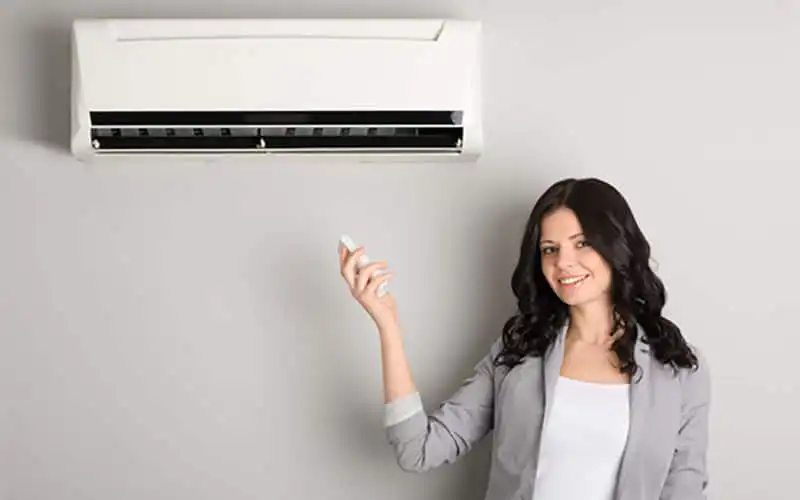
The high wall mount is the most common type of ductless indoor unit and the one most people picture when they think of a mini split. It mounts near the ceiling on an interior wall and distributes air downward across the room.
Best for: Bedrooms, living rooms, garages, home additions, and any standard room with available wall space.
Pros:
- Most cost-effective to purchase and install
- Easiest to access for maintenance and filter cleaning
- Often includes advanced features like occupancy sensing and directional airflow control
- Available in the widest range of sizes and capacities
Cons:
- Visible on the wall, which some homeowners find less aesthetically appealing
- Protrudes from the wall by several inches
High wall units are the go-to recommendation for most residential applications. They are straightforward to install, reliable over the long term, and efficient. For the vast majority of homes in Acadiana, this is the right choice.
Floor Mount
A floor mount unit installs low on the wall, near the floor, rather than up near the ceiling. It can be partially recessed into the wall for a cleaner look, though it will still extend a few inches into the room.
Best for: Spaces where wall space is limited at ceiling height, rooms with large windows that take up most of the upper wall, attics with sloped ceilings, or homes where the layout makes a high wall unit impractical.
Pros:
- Good for spaces where a wall mount would not fit or would be blocked
- Still very efficient
- Easier to access and feel the airflow directly
Cons:
- Air distribution is less even in taller rooms since cool air naturally rises
- Typically does not include the same advanced sensor features as high wall units due to placement
Floor mount units are a smart workaround in situations where a high wall unit simply does not work. They are not the first choice for every room, but they solve real problems in the right settings.
Ceiling Cassette
A ceiling cassette is installed directly into the ceiling so that only the face of the unit is visible, flush with or slightly below the ceiling plane. Air is distributed in multiple directions from the center of the unit, which can improve even coverage across a larger space.
Best for: Commercial spaces, open floor plans where wall-mounted units are impractical, or homeowners who want the indoor unit to be as unobtrusive as possible.
Pros:
- Very clean appearance since the unit sits in the ceiling
- Good air distribution in rooms where a single wall-mounted head might leave dead zones
- Works well in open or square-shaped rooms
Cons:
- Significantly more expensive to install because it requires ceiling framing and opening work before installation
- Requires a condensate pump to drain moisture upward against gravity, which adds a component that needs periodic maintenance
- Harder to access for filter cleaning and service
- Typically does not include the same occupancy detection features as wall mount units
Ceiling cassettes are installed on a case-by-case basis and are generally recommended only when the other unit types are not a good fit for the space.
Single-Zone vs. Multi-Zone Systems
A single-zone mini split system pairs one outdoor unit with one indoor head. This is the right choice when you need to condition a single room or area, like a garage, a sunroom, a detached guest suite, or a bedroom that your central system does not reach well.
A multi-zone system connects one outdoor unit to two or more indoor heads, each controlling its own zone independently. This is the better fit when you want to condition several rooms with individual temperature control without expanding ductwork through the whole house.
One important thing to keep in mind: the outdoor unit has a total capacity limit. Adding more indoor heads does not increase total output. Your HVAC technician will size the system to match the actual cooling and heating load across all your zones.
Cooling Only vs. Heat Pump
Most ductless mini splits sold today function as heat pumps, meaning they both cool your home in summer and heat it in winter using the same refrigerant cycle. For Acadiana homeowners, this is almost always the right choice.
A cooling-only unit cannot be retrofitted to add heating later. And in south Louisiana, even though our winters are mild, there are weeks when temperatures dip enough that supplemental heating in a room or zone is useful. The cost difference between a cooling-only and a heat pump unit is usually small, and the added flexibility is worth it.
When Does a Ductless System Make Sense in Acadiana?
Mini splits are a great fit in a number of common situations:
No existing ductwork: Older homes in the Acadiana area were often built without central air. Installing new ductwork can be expensive and disruptive. A multi-zone mini split can condition the whole home without tearing into walls or ceilings.
Home additions: Adding a room, converting a garage, or finishing an attic usually means no existing duct connections. A mini split handles the new space without needing to modify or extend the central system.
Garage or workshop: Ductwork in garages is not permitted in most jurisdictions due to fire code concerns. A ductless unit is the practical solution for year-round comfort in a garage.
Supplemental cooling for one room: If one room in your home is always warmer or more humid than the rest, a single-zone mini split can fix that without replacing or modifying your entire HVAC system.
Older homes with limited duct capacity: If your central system’s ducts are undersized or poorly routed, a mini split in a problem area is often more practical than a full duct modification.
What About Homes With Existing Ductwork?
If your home already has a functioning ducted central air system, a mini split is not always the first answer for whole-home comfort. A properly sized and maintained central AC system will generally deliver more consistent comfort throughout the home at a lower equipment cost.
That said, mini splits pair very well with a central system for problem areas, bonus rooms, or spaces the ductwork never quite served well. You do not have to choose one or the other.
If you are unsure whether your existing central system is performing well, an AC tune-up can identify any issues before you invest in additional equipment. And if indoor humidity is your main concern even with a working AC system, it may be worth looking at a whole-home dehumidifier instead.
Brands We Install
Southern Air installs ductless systems from trusted manufacturers including Mitsubishi, Daikin, Carrier, and American Standard. All of these brands offer reliable, efficient units well-suited for Louisiana’s climate.
Ready to Talk About a Ductless Mini Split for Your Acadiana Home?
Southern Air has been serving the Acadiana area since 1984. Our team can assess your home, recommend the right type and number of indoor heads, and handle the full installation with upfront pricing and no surprises.
We also offer flexible financing options so you can get the right system without waiting.
Call us at (337) 202-5755 or schedule a consultation online to get started.